
How is Artificial Intelligence like a mother?
María Zalbidea tells us on her website www.cosiendolabrechadigital.com The importance of measuring technology in the home to demonstrate that the role of parents is irreplaceable, even in the face of artificial intelligence.
Even though the question might surprise you – because it's true that a mother has no competition and never will – artificial intelligence It looks more like a mother than you think.
Yes, yes, I'll show you.
Artificial intelligence is one of the clear trends of this 2020. But what really is artificial intelligence? It is the combination of algorithms designed with the purpose of creating machines that exhibit the same capabilities as human beings. A technology that still seems a bit distant and like science fiction, but which for some years now has been present in our day-to-day lives at all hours.
Experts say that artificial intelligence has arrived to make our lives easier. It removes spam from Gmail, suggests the best songs on Spotify, knows our favourite series and makes it available when we turn on our devices, it helps us get to a place thanks to Google Maps…
Furthermore, artificial intelligence Solve problems agilely. Don't mothers do this all the time? There are no challenges that we face when it comes to solving problems in real time.
It's multitaskingAnd for multitasking, a mother who is capable of having dinner with her children while answering a pre-teen's question about Fortnite, at the same time as an 11-year-old wants to talk about one of her friends and her TikTok videos, and the little one wants her to sing a song from his favourite cartoons because if not, he won't finish his cauliflower. In short, a mother is capable – like artificial intelligence – of doing many things at once.
But I wonder: can a mother learn something from artificial intelligence and thereby better bridge the digital divide?
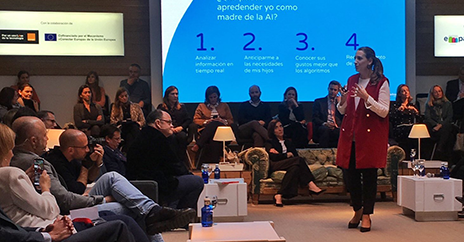
Last January, I was asked to speak at the "Cómo" space in Madrid, hosted by Javi Nieves, on the impact of screens on family life. I covered what I believe parents can learn from artificial intelligence:
- Analyse real-time information. Look at your children, observe them, dedicate time to them. Observe the signals of help they send us in real time, react and make decisions.
- Anticipating my children's needs. As a mother, I aspire to know their needs almost before they ask. Practise active listening like Siri, Amazon Alexa, or Google Assistant. Be attentive to what they need so you can connect with them.
- Knowing your tastes better than algorithms. One of the challenges for parents today is teaching their children to know themselves, and in doing so, they will be able to self-regulate. I believe it's important that Netflix or Amazon's algorithms don't know my children's tastes better than I do.
- Image recognition. Scan your children daily; look at, observe their faces, their gestures… You recognise better than anyone what they feel and think.
Lately, I've been really pushing the idea of measuring the technological temperature of your home. I think it's essential, and I believe that measuring helps us to move forward and continue building that healthy relationship with technology in your home.
